
S7900
S7900 Odd Form Insertion Machine
S7900 odd form insertion machine for relays, transformers and connectors: 4 heads, ±0.05 mm, tape/tube/tray/bowl feeders, lead clinching. Free BOM review.
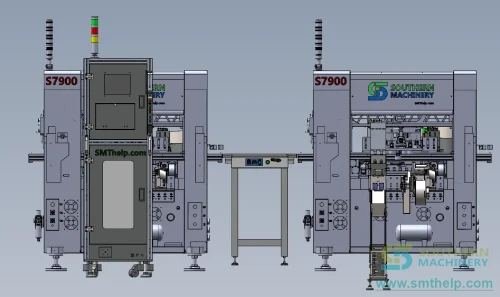
Automate the awkward parts your SMT line can’t place.
Relays, transformers, connectors, large capacitors and coils usually stay manual. The S7900 handles them with four vision-guided heads, nozzle or gripper pickup, flexible feeders and optional lead clinching.
Feeder, gripper and clinch design are confirmed after we review your BOM, drawings and samples.
At a glance
- 4 — insertion heads
- ±0.05 mm — placement accuracy (S7900IV-W)
- 0–360° — insertion direction
- 4,700/h — relay insertion example vs 1,000/h manual
- 5 — workers replaced in the relay example
- <2 yrs — indicative payback
The last manual job after SMT
Odd-form parts stay manual because every package is different. Here is what that costs.
- Skilled hands for every relay: Heavy, irregular parts need careful operators, and output depends on them.
- Floating parts in the wave: Heavy components tilt or lift before soldering when leads are not secured.
- Every part comes packed differently: Tape, tube, tray and bulk packaging all arrive at the same bench.
- Changeovers eat engineering time: High-mix production means new setups every week.
- Bent pins damage holes: Forcing a misaligned connector creates scrap and hidden defects.
- Labour cost is hard to control: Output swings with staffing, fatigue and turnover.
One platform for many odd-form parts — Feature, Advantage, Benefit
Six functions that make the S7900 a flexible odd-form cell, not a one-part special machine.
Heads: Four insertion heads
Multi-component configurations.
- Feature: Four insertion heads with 0.7 s per component on the S7900IV.
- Advantage: Several different odd-form parts are inserted in one pass.
- Benefit: One machine replaces a manual odd-form bench.
Key points: 4 heads · 0.7 s/component · Nozzle or gripper
Feeders: Tape, tube, tray and bowl feeders
Matched to each BOM item.
- Feature: Radial tape, vertical taping, horizontal tape, tube, bowl and tray feeder layouts.
- Advantage: Parts are fed in the packaging they arrive in.
- Benefit: No repacking cost and faster material changeover.
Key points: Tape / tube · Tray / bowl · Custom feeders
Vision: ±0.05–0.06 mm accuracy
Top and bottom CCDs.
- Feature: 1 top MARK CCD and 4 bottom component CCDs; accuracy ±0.06 mm (S7900IV) or ±0.05 mm (S7900IV-W), CPK ≥1.0.
- Advantage: Leads are checked and aligned before insertion.
- Benefit: Fewer bent pins and no damaged PCB holes.
Key points: ±0.05 mm · 5 CCDs · CPK ≥1.0
Clinch: Lead clinching unit
Standard on S7900IV-W.
- Feature: Bottom clinching unit bends leads under the board; standard on the S7900IV-W.
- Advantage: Heavy parts stay seated through handling and wave soldering.
- Benefit: No floating relays or transformers after soldering.
Key points: Clinch std (IV-W) · Inward / outward · Up to 5 kg PCB
Sizes: Parts up to φ50 mm
Large and heavy components.
- Feature: Components up to φ30 (17 × 17) mm on S7900IV and φ50 (35 × 35) mm on S7900IV-W; insertion force up to 98 N.
- Advantage: Covers relays, transformers, connectors, capacitors, coils and fuses.
- Benefit: More of your BOM leaves the manual bench.
Key points: Up to φ50 mm · ≤98 N force · PCB up to 500 mm
Line: Inline with loaders and other cells
L→R or R→L.
- Feature: Left-to-right or right-to-left conveyor, Windows operation and vision programming; pairs with PCB loaders, S3000/S3010A and wave soldering.
- Advantage: Builds a continuous automatic THT line.
- Benefit: Lower labour per board across the whole line.
Key points: L→R / R→L · Windows · Loader ready
Key specifications for project evaluation
Values support initial evaluation and remain subject to final technical confirmation against your board size, component mix and line layout.
Models
| Parameter | S7900IV / S7900IV-W |
|---|---|
| Size (L×W×H) | 1300×1700×2000 mm / 1550×1900×2100 mm |
| Weight | 1650 kg / 1750 kg |
| Insertion heads | 4 / 4 |
| Max component size | φ30 (17×17) mm / φ50 (35×35) mm |
| Component height | ≤30 mm / ≤25 mm |
| Speed per component | 0.7 s / 2 s with bent feet |
| Placement accuracy | ±0.06 mm / ±0.05 mm (CPK ≥1.0) |
| Insertion force | ≤98 N / ≤29.4 N |
| Insertion direction | 0–360° / 0–360° |
Board & utilities
| Parameter | S7900IV / S7900IV-W |
|---|---|
| PCB size | 70×70–410×500 mm / 70×70–450×400 mm |
| PCB thickness | 0.6–2.0 mm |
| Max PCB weight | 2 kg / 5 kg |
| Conveyor | Chain, 900±20 mm / Belt, 750±20 mm |
| Lead clinching | Not applicable / Standard |
| Vision | Top MARK CCD ×1, bottom component CCD ×4 |
| Air | 0.5–0.65 MPa |
| Power (max / running) | 5.4/3.3 kW / 6.6/3.5 kW |
| Operating system | Windows |
Values from the S7900 THT odd form insertion machine catalog. Output and ROI figures are source examples for a relay application; they are validated case by case with your BOM, shifts and labour cost.
Compatibility and interfaces: Relays, Transformers, Connectors, Capacitors, Coils, Fuses, Tape / tube / tray / bowl feeders, Nozzle or gripper
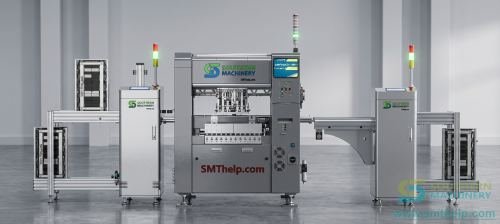
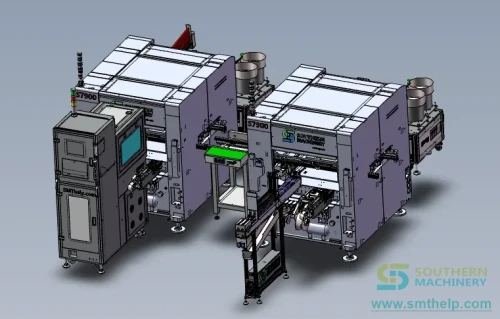
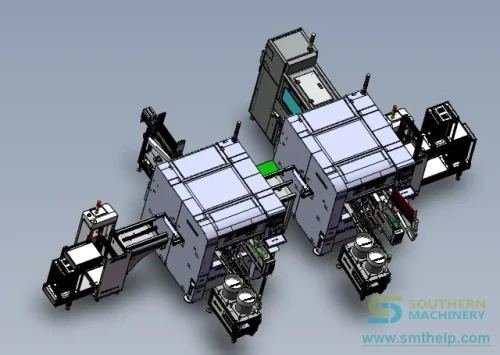
S7900 configurations
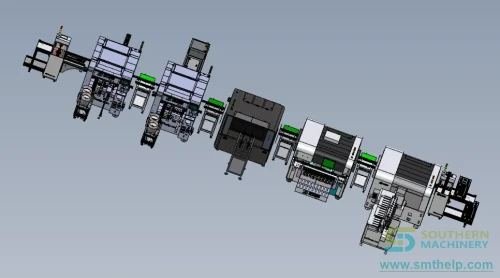
See odd-form automation in motion
Interactive 3D demo
Open the interactive 3D model of the S7900VI odd-form insertion machine and line (opens in a new tab).
From sample review to lifetime support
- 1 · Free application review — Send PCB files, BOM and component samples. An engineer checks fit before any quotation.
- 2 · Live demo with your parts — We run your own components on the machine and share the video and an ROI estimate.
- 3 · Configuration & quote — Feeders, tooling and line interfaces are matched to your board; quote the same working day.
- 4 · Installation & training — Engineer-guided startup, programming and operator training, on site or remote.
- 5 · Lifetime support — Remote diagnosis, spare parts from Shenzhen and a fix plan within 3 days.
Frequently asked questions
Which components can the S7900 insert?
Relays, transformers, connectors, capacitors, coils, fuses and similar odd-form THT parts. Feasibility depends on package, lead geometry and a sample test.
Can it use our existing packaging?
Yes. Tape, tube, tray and bowl feeders are configured to each BOM item.
Does it prevent floating before wave soldering?
The S7900IV-W has a lead clinching unit as standard to secure parts before soldering.
How fast and accurate is it?
0.7 s per component on the S7900IV (2 s with bent feet on the IV-W); accuracy ±0.06 mm and ±0.05 mm respectively.
How fast do we get a quote?
Send your PCB size, BOM or component list, target output per shift and destination country. We reply within 2 hours in working time and quote the same day; a free live demo with your own components can be arranged before you order.
What about installation, training and spare parts?
Installation and operator training are included in the project plan (on site or remote). Spare parts ship from Shenzhen, and our engineers give a remote diagnosis and fix plan within 3 days.
Engineering Review
Send PCB details for a practical machine recommendation.
Useful details: PCB type, board size, component list, monthly volume, current worker count, line layout and target automation goal.
Next step: Share PCB files, BOM, component drawings and package photos. We review feeders, grippers and clinch feasibility and quote the same day.
Engineering Review
Send PCB details for a practical machine recommendation.
Useful details: PCB type, board size, component list, monthly volume, current worker count, line layout and target automation goal.
Share PCB files, BOM, component drawings and package photos. We review feeders, grippers and clinch feasibility and quote the same day.