
SM-460
SM-460 Enclosed PCB Magazine Loader
SM-460 enclosed PCB magazine loader for SMT line entry: 250/330/390/460 mm width classes, PLC with touch HMI, stack light, built to your rail.
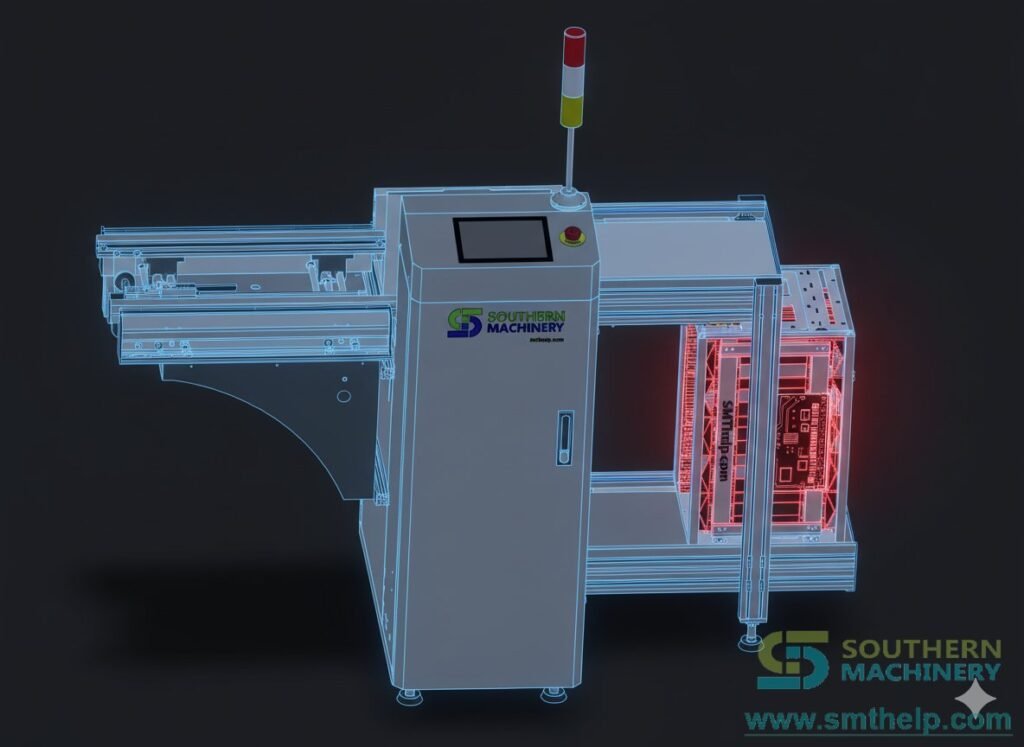
The printer never waits for a human hand again.
The SM-460 is a PLC-controlled, enclosed loader that stands at your SMT line entry and pushes bare or populated boards out of the magazine onto the rail, board by board.
Four board-width classes, a touch HMI, a tri-colour stack light and a full sheet-metal frame; belt width and frame are built to your line.
Configuration is engineered against your rail width and line layout before quotation.
At a glance
- 250 / 330 / 390 / 460 mm — board-width classes
- PLC + touch HMI — control
- 3-colour — stack light for line status
- ≈ 200 kg — machine weight
- ≈ 35 working days — custom build lead time
- 1 year — warranty, commissioning and training included
The cost of hand-loading boards
Someone has to lift boards out of the magazine and place them on the rail, one at a time, all shift.
- One operator, one job: Pulling boards from magazines is work a PLC does better, and a break stops the line.
- Missed and reversed boards: Manual placement drops or reverses boards, risking damaged panels.
- Starved printer: Late boards leave the printer idle between cycles.
- No status visibility: Nobody sees a low magazine until the line stops.
- Handling damage: Populated boards on a second pass carry ESD and mechanical risk with every touch.
What the SM-460 changes at your line entry — Feature, Advantage, Benefit
Four functions from the SM-460 product data.
Productivity: Automatic magazine feeding
Elevator indexing and pusher.
- Feature: Magazine rack with automatic elevator indexing that pushes bare or populated boards onto the rail at the SMT line entry.
- Advantage: Boards arrive on machine timing, and the PLC exchanges demand / ready signals with downstream equipment.
- Benefit: The printer runs continuously and the operator is freed for other work.
Key points: Auto elevator · PLC signalling · Bare or populated boards
Visibility: Touch HMI and stack light
Run / wait / fault at a glance.
- Feature: Touch-screen HMI for settings and a tri-colour stack light (red / amber / green) for status.
- Advantage: A low magazine or fault is visible across the floor.
- Benefit: Planned magazine refills instead of reactive line stops.
Key points: Touch HMI · 3-colour stack light · Emergency stop
Safety: Enclosed working zone
Full sheet-metal frame.
- Feature: Working zone enclosed in a full sheet-metal frame with viewing windows; emergency stop at the control console.
- Advantage: Dust is kept off boards and hands out of the mechanism.
- Benefit: Safer line entry with fewer handling defects.
Key points: Sheet-metal frame · Viewing windows · E-stop
Fit: Built to your rail
Four width classes.
- Feature: Board-width classes up to 250 / 330 / 390 / 460 mm; belt width and main frame material customisable.
- Advantage: Belt width, magazine pitch and signalling are matched to the line before quotation.
- Benefit: The loader drops into your line without rework.
Key points: 250–460 mm classes · Custom belt width · Custom frame
Key specifications for project evaluation
No SM-460 page exists on www.smthelp.com; values are from the SM-460 product page (supplier data sheet for this platform).
SM-460
| Parameter | SM-460 |
|---|---|
| Machine type | Enclosed SMT line board loader, line-entry transfer equipment |
| Function | Feeds bare or populated PCBs from magazines to the downstream machine at the SMT line start |
| Board width classes | Up to 250 / 330 / 390 / 460 mm |
| Belt width | Customisable to your board and rail dimensions |
| Frame | Full sheet-metal frame; main frame material customisable |
| Control system | PLC with touch-screen HMI |
| Status indication | Tri-colour stack light (red / amber / green) |
| Safety | Emergency stop at the control console; enclosed working zone with viewing windows |
| Machine weight | Approx. 200 kg |
| Lead time | Custom build approx. 35 working days; ask about ex-stock units for standard widths |
| Warranty | 1 year, with commissioning and operator training |
Load-rating values vary by width class and are re-verified at order.
Compatibility and interfaces: PLC, Touch HMI, Stack light, SMEMA line entry
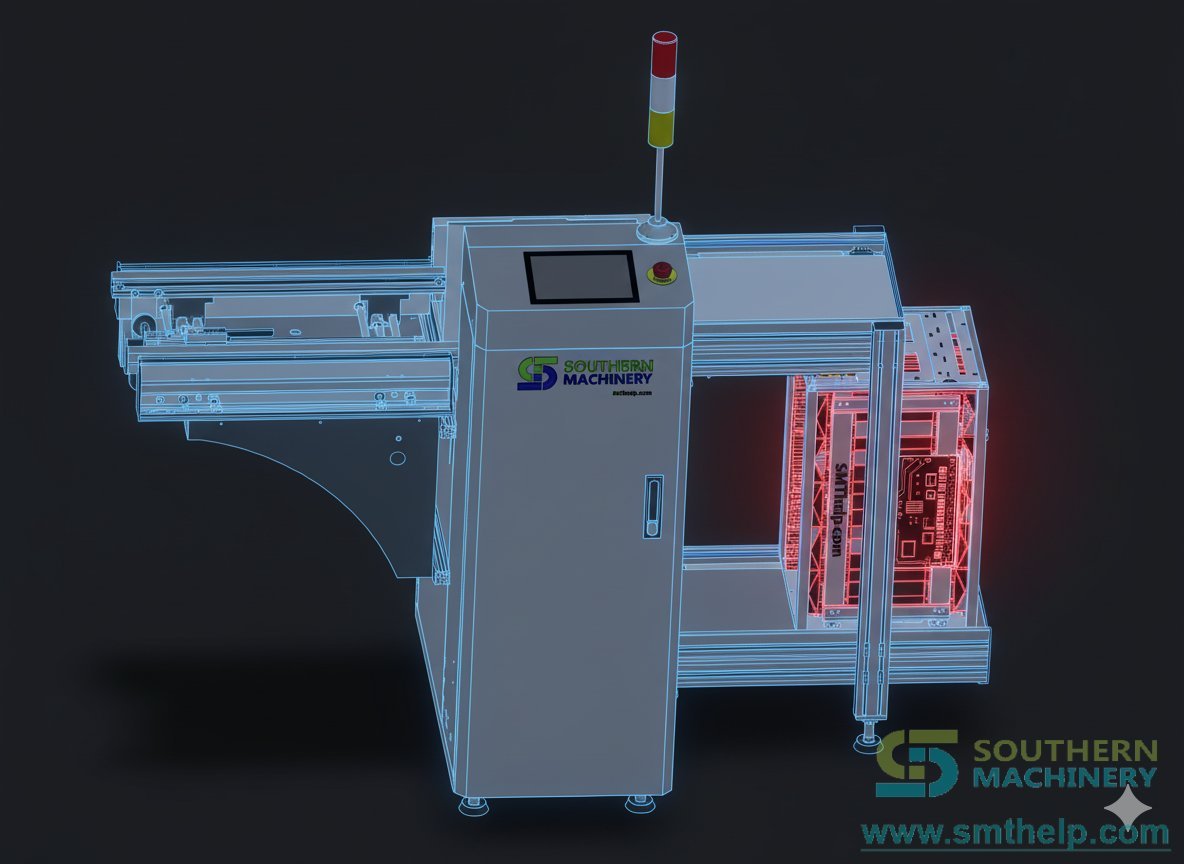
SM-460 views
How we qualify your loading solution
- 1 · Line survey — Send rail width, board sizes and line speed.
- 2 · Engineering — Belt width, magazine pitch and downstream signalling matched.
- 3 · Build and test — Custom build approx. 35 working days, tested with your board sizes.
- 4 · Commissioning — Installation with line signal integration and operator training.
- 5 · Warranty — 1-year warranty with remote support and spare parts.
Frequently asked questions
What board sizes does the SM-460 handle?
Four width classes covering boards up to 250 / 330 / 390 / 460 mm wide. Belt width and magazine pitch are customised to your boards.
Where does it sit in the line?
At the SMT line entry, before the solder paste printer. It pushes boards out of the magazine onto the rail; a matching unloader collects boards at the line end.
How does it talk to the rest of the line?
The PLC exchanges demand / ready signals with downstream equipment, so boards are released only when the next machine is ready.
Is it enclosed?
Yes. The working zone is enclosed in a full sheet-metal frame with viewing windows, and the emergency stop is at the control console.
How long does delivery take?
Configured units are custom built in approximately 35 working days. Standard-width units may be available ex-stock.
Engineering Review
Send PCB details for a practical machine recommendation.
Useful details: PCB type, board size, component list, monthly volume, current worker count, line layout and target automation goal.
Next step: Send your rail width, board dimensions, line speed and downstream machines; we return the matching configuration and a quotation with lead time.
Engineering Review
Send PCB details for a practical machine recommendation.
Useful details: PCB type, board size, component list, monthly volume, current worker count, line layout and target automation goal.
Send your rail width, board dimensions, line speed and downstream machines; we return the matching configuration and a quotation with lead time.