
S-AGV60C
S-AGV60C Wave Soldering Pallet AGV
S-AGV60C magnetic-guided AGV for wave soldering pallet return: 60 kg load, 20–45 m/min, 2 cm stopping accuracy, 15+ h per charge, RFID stations, 8 sensors.
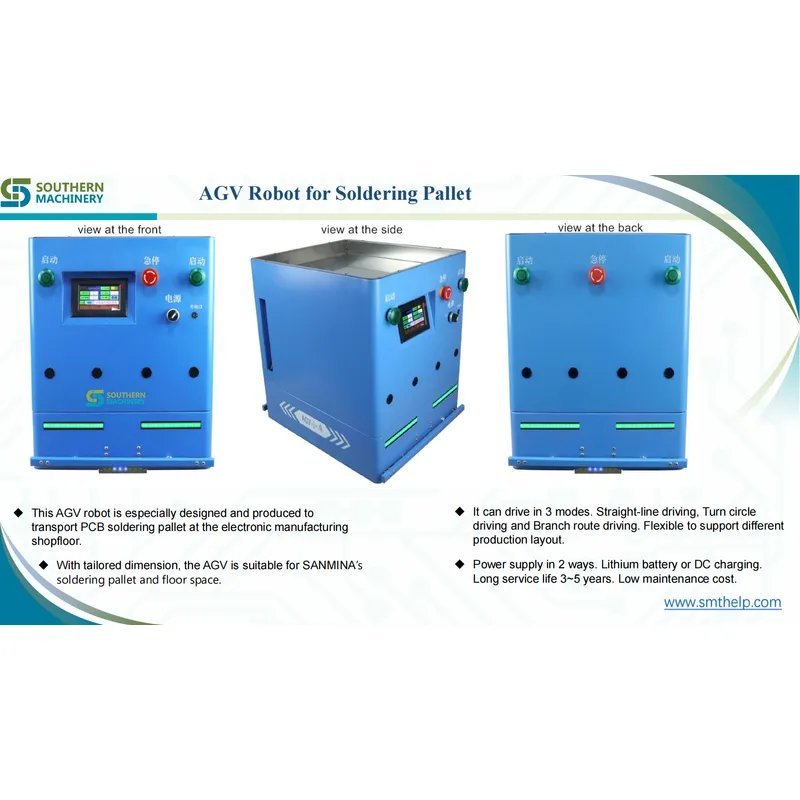
Keep soldering pallets moving.
The S-AGV60C is a magnetic-guided AGV that builds a repeatable return route between wave soldering and upstream workstations, without manual cart runs.
RFID station cards, a touch-screen HMI and ultrasonic obstacle sensing are configured around your pallet, stations and factory path.
Specifications from www.smthelp.com (S-AGV60C AGV robot) and the S-AGV60C operational manual.
At a glance
- 60 kg — maximum loading capacity
- 20–45 m/min — adjustable speed
- 2 cm — stopping accuracy
- 15+ h — driving time when fully charged
- 0.8 m — minimum turning radius
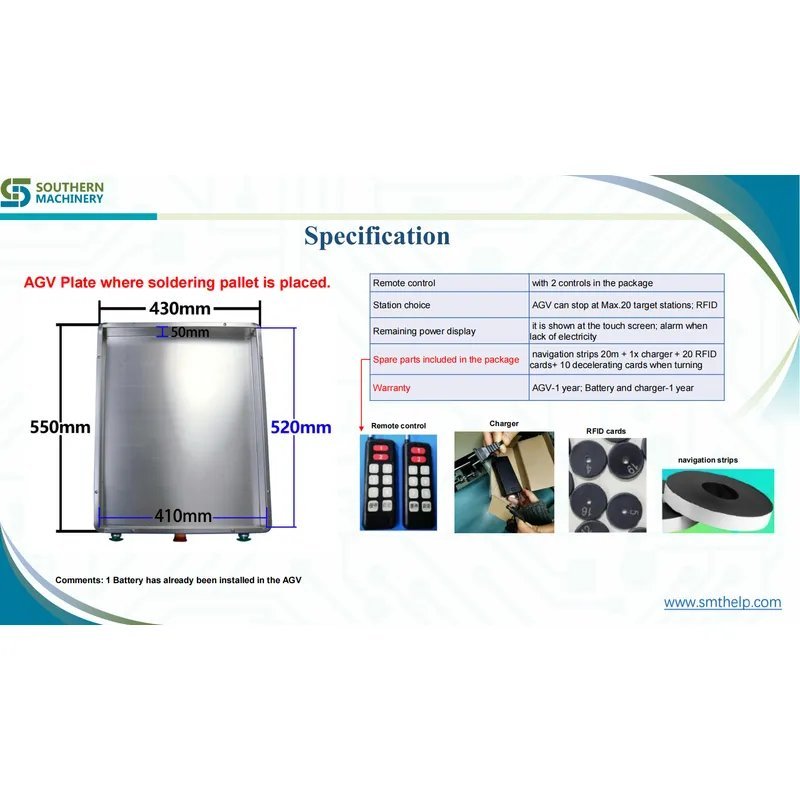
- 520 × 430 × 50 mm — plate for the soldering pallet
Why pallet return is worth automating
Wave soldering pallets travel the same route all shift, usually on a cart pushed by an operator.
- Manual cart runs: Operators walk pallets back to loading stations instead of working.
- Irregular timing: Pallets arrive when someone has time, not when the line needs them.
- Product damage: Irregular manual handling damages pallets and boards.
- Untidy aisles: Ad-hoc carts block aisles and mix with pedestrian traffic.
S-AGV60C features — Feature, Advantage, Benefit
Four functions documented for the S-AGV60C.
Stations: RFID station selection
Up to 20 targets.
- Feature: RFID station cards identify working points on the magnetic route; up to 20 target stations with station-specific dwell or output logic.
- Advantage: Repeatable stops for multi-point material flow.
- Benefit: Pallets arrive where and when the process needs them.
Key points: RFID · Up to 20 stations · Programmable dwell
Route: Magnetic strip navigation
Forward and backward.
- Feature: Magnetic strip navigation; straight-line and turn-circle driving as standard, branch-route driving optional; minimum turning radius 0.8 m.
- Advantage: A defined, predictable route.
- Benefit: Safer than human-driven carts on a fixed path.
Key points: Magnetic strip · Straight + circle · Branch route (option)
Power: Two power approaches
Battery swap or DC charging.
- Feature: Lithium battery 24 V 20 Ah, by battery replacement or DC charging; more than 15 hours of driving when fully charged, 5 hours charging time, 200 hours standby.
- Advantage: Charging fits the shift plan.
- Benefit: Multi-shift pallet return without downtime.
Key points: 24 V 20 Ah Li · 15+ h drive · 5 h charge
Safety: Ultrasonic obstacle sensing
8 sensors.
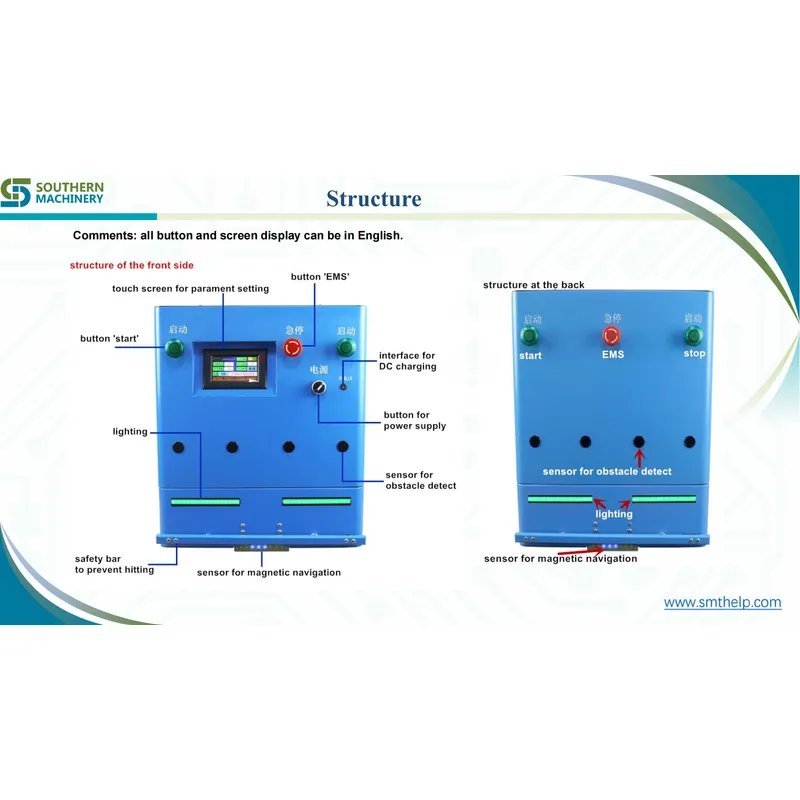
- Feature: Eight ultrasonic obstacle sensors; brushless motor differential drive; parameters set on the touch screen or by remote control.
- Advantage: The AGV stops when it meets an obstacle.
- Benefit: Controlled indoor route alongside people.
Key points: 8 ultrasonic sensors · Touch screen / remote · Brushless drive
S-AGV60C parameters
Values from www.smthelp.com; RFID stations, display size and warranty from the S-AGV60C operational manual.
Parameters
| Parameter | S-AGV60C |
|---|---|
| Navigation method | Magnetic strips; forward and backward |
| Standard driving modes | Straight-line driving + turn-circle driving |
| Optional driving mode | Branch route driving |
| Max. loading capacity | 60 kg |
| Max. speed | 20–45 m/min, adjustable |
| Min. turning radius | 0.8 m |
| Stopping accuracy | 2 cm |
| Power supply | Lithium battery 24 V 20 Ah, replacement or DC charging |
| Power life | More than 15 hours when fully charged |
| Standby time (no load, no driving) | 200 hours |
| Charging time | 5 hours |
| AGV outer dimension (L × W × H) | 550 × 450 × 550 mm |
| Plate dimension (L × W × H) | 520 × 430 × 50 mm (soldering pallet placement) |
| AGV net weight | Approx. 35 kg |
| Parameter setting | Touch screen LCD (4.3-inch) or remote control |
| Drive | Brushless motor, differential |
| Obstacle sensors | Ultrasonic, 8 sensors in total |
| Station choice | Up to 20 targets, RFID |
| Warranty (manual) | AGV, battery and charger: 1 year |
Route performance depends on the approved layout, aisle widths, turning geometry and station logic; real cycle time is calculated from your route.
Compatibility and interfaces: Magnetic navigation, RFID stations, Wave soldering pallets, Touch screen, Ultrasonic sensing
S-AGV60C views
Watch pallet return and route setup
Questions to resolve before configuration
- 1 · Application review — Pallet dimensions, weight and centre of gravity.
- 2 · Route engineering — Turning geometry and RFID station plan.
- 3 · Training — For the approved configuration.
- 4 · After-sales — Remote technical follow-up.
Frequently asked questions
What load can the S-AGV60C carry?
60 kg maximum, on a 520 × 430 × 50 mm plate designed for soldering pallets.
Which route modes are standard?
Straight-line and turn-circle driving; branch-route driving is optional and needs layout confirmation.
How are stations identified?
By RFID station cards, with up to 20 target stations and programmable dwell and output behaviour.
How long does it run?
More than 15 hours when fully charged, with a 5-hour charging time. Batteries can also be replaced.
What site information is needed?
Route drawing, aisle and turn dimensions, floor condition, station sequence, pallet data, shift pattern, required cycle and interface signals.
Engineering Review
Send PCB details for a practical machine recommendation.
Useful details: PCB type, board size, component list, monthly volume, current worker count, line layout and target automation goal.
Next step: Share pallet dimensions and weight, station sequence, floor plan and target cycle; we review the configuration.
Engineering Review
Send PCB details for a practical machine recommendation.
Useful details: PCB type, board size, component list, monthly volume, current worker count, line layout and target automation goal.
Share pallet dimensions and weight, station sequence, floor plan and target cycle; we review the configuration.