
S3010A
S3010A High-Speed Radial Insertion Machine
S3010A radial insertion machine: 12,000 CPH rated (10,000 actual), 2.5–10.0 mm spans, parts to 22 mm, value/polarity check, auto PCB loading. Free demo.
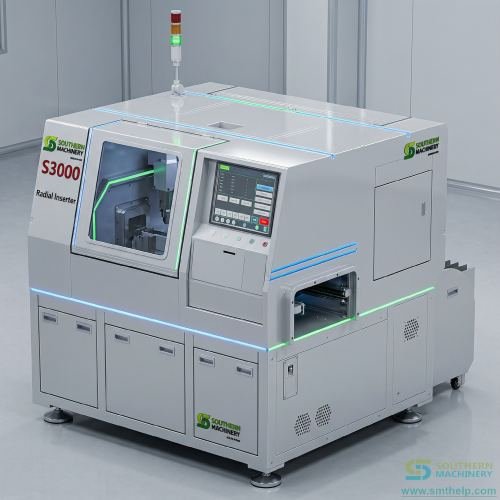
Run radial insertion at line speed, not hand speed.
The S3010A combines a servo insertion head, N-type clinch, machine vision and automatic PCB loading/unloading for high-volume radial THT production on power supplies, LED drivers, appliances and automotive boards.
12,000 CPH rated, 10,000 CPH actual speed (both published in the S3010A datasheet). Output on your own board is confirmed with a sample run.
At a glance
- 12,000 CPH — rated throughput; 10,000 CPH actual speed
- 2.5–10.0 mm — lead spans, including 3.5 mm (single to quad-span tooling)
- 50–400 mm — PCB from 50×50 to 400×400 mm
- 22 mm — maximum component height, no derate
- 400×400 — mm maximum PCB size
- 10–35° — adjustable clinch angle
When manual radial insertion becomes the bottleneck
Growing volume exposes every weakness of hand insertion. These are the issues that bring high-volume EMS factories to the S3010A.
- SMT is fast, THT is not: Boards wait in front of the manual insertion line while SMT runs ahead.
- Quality drifts by shift: Night-shift defect rates differ from day shift because the process depends on people.
- Clinch is inconsistent: Hand-bent leads are uneven, so parts tilt or lift during wave soldering.
- Operators load boards all day: Manual PCB handling wastes time between insertion cycles.
- Wrong part, wrong place: Similar-looking capacitors get swapped without a programmed sequence.
- Customers audit the process: Automotive and appliance customers want a documented, repeatable process.
Built for high-volume radial lines — Feature, Advantage, Benefit
Six functions that turn the S3010A into a line-speed machine.
Speed: 12,000 CPH rated, 10,000 CPH actual
High-speed radial sequence.
- Feature: Radial insertion at a rated 12,000 CPH, with 10,000 CPH published as the actual speed.
- Advantage: Matches the pace of an SMT line feeding THT boards.
- Benefit: THT stops being the bottleneck and the whole line ships more boards.
Key points: 12,000 CPH rated · 10,000 CPH actual · 10 to 100 feeder inputs
Head: Servo insertion head + N clinch
13.0 mm servo head and N-type clinch base.
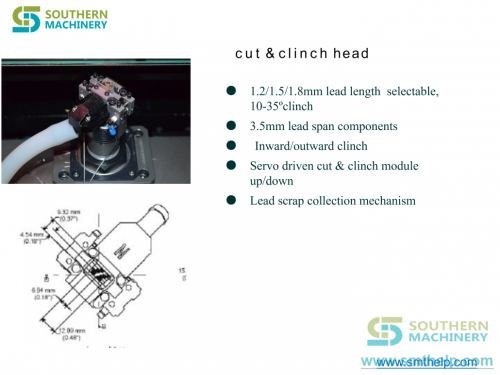
- Feature: Servo-motor-driven insertion head (13.0 mm) and an N-type clinch base; clinch length 1.5–2.2 mm, angle 10–35°.
- Advantage: Controlled, repeatable insertion and lead forming on every part.
- Benefit: Parts stay seated through wave soldering, with fewer touch-ups.
Key points: Servo head · N-type clinch · Inward/outward
Vision: Machine vision correction
Fiducial recognition and auto alignment.
- Feature: Industrial camera reads fiducial marks and automatically aligns insertion positions.
- Advantage: PCB tolerances and fixture variation are corrected before insertion.
- Benefit: Higher first-pass yield and less rework.
Key points: Fiducial marks · Auto align · Vision teach
Handling: Automatic PCB loading/unloading
Hands-off board flow.
- Feature: Manual load or automatic in-line PCB loading and unloading; the loader magazine rack holds up to 50 boards and the empty rack is exchanged automatically.
- Advantage: No operator time is spent feeding and removing boards.
- Benefit: One operator can supervise the machine instead of feeding it.
Key points: In-line load/unload · 50-board magazine rack · SMEMA line ready
Software: Gerber/Excel programming
USB data transfer.
- Feature: Programs are created from Gerber or Excel data and transferred by USB; the program aligns positions automatically.
- Advantage: The camera visual operating system lets an operator finish a new PCB insertion program within 5 minutes.
- Benefit: Faster new product introduction for high-mix customers.
Key points: Gerber / Excel · USB import · English UI
Range: Full radial component range
Taped vertical components.
- Feature: Capacitors, transistors, LEDs, key switches, resistors, connectors, fuse blocks and other tape-packed radial parts; PCB thickness 0.79–2.36 mm.
- Advantage: One machine covers most radial parts in a typical BOM.
- Benefit: Less manual insertion left after the machine.
Key points: Capacitors / LEDs · Switches / fuses · 0.79–2.36 mm PCB
Key specifications for project evaluation
Values support initial evaluation and remain subject to final technical confirmation against your board size, component mix and line layout.
Insertion
| Parameter | S3010A |
|---|---|
| Specification speed | 12,000 CPH rated; 10,000 CPH actual speed |
| Lead span | 2.5–10.0 mm including 3.5 mm; single, dual, triple and quad-span tooling (quad-span optional) |
| Insertion direction | 0–360°, 1° increments |
| Insertion head | Servo-motor driven (13.0 mm), N-type clinch base |
| Clinch length / angle | 1.5–2.2 mm / 10–35° (adjustable) |
| Feeder inputs | 10 on the machine base, scalable from 10 to 100 inputs (In-Line or Straight-Back) |
| Components | Standard tape-packed radial-lead parts, up to 22 mm tall |
Machine
| Parameter | S3010A |
|---|---|
| PCB size | 50 × 50 mm to 400 × 400 mm |
| PCB thickness | 0.79–2.36 mm |
| PCB transfer | Manual load or automatic in-line load / unload (table is non-rotary) |
| Coordinate correction | Machine vision |
| Core machine size (L×W×H) | 1800 × 1600 × 1800 mm |
| Weight | Approx. 1000 kg |
| Power | 220 V AC single phase, 50/60 Hz |
| Air | 0.6 MPa, 0.3 m³/min |
| Ambient temperature | 10–35 °C |
Values from the S3010A datasheet as published on www.smthelp.com. 12,000 CPH is the rated throughput and 10,000 CPH the actual speed; output on your board depends on component mix, board layout and feeder count, and is confirmed with a sample run.
Compatibility and interfaces: Electrolytic capacitors, Transistors, LEDs, Key switches, Resistors, Connectors, Fuse blocks, Gerber / Excel, USB
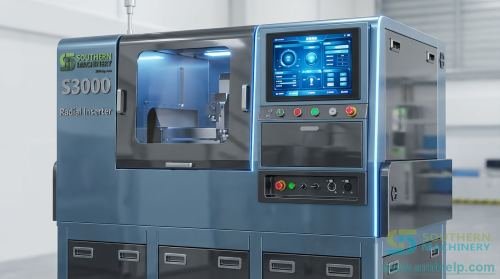
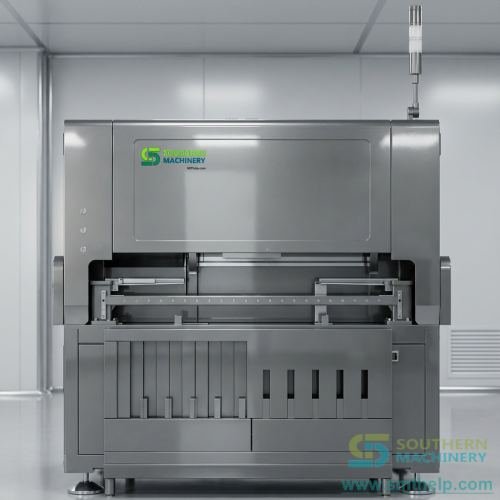
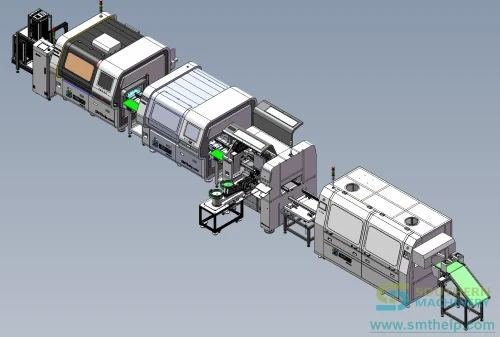
S3010A machine and details
Watch the S3010A in production
Interactive 3D demo
Open the interactive S3010A product page with its 3D insertion demo (opens in a new tab).
From sample review to lifetime support
- 1 · Free application review — Send PCB files, BOM and component samples. An engineer checks fit before any quotation.
- 2 · Live demo with your parts — We run your own components on the machine and share the video and an ROI estimate.
- 3 · Configuration & quote — Feeders, tooling and line interfaces are matched to your board; quote the same working day.
- 4 · Installation & training — Engineer-guided startup, programming and operator training, on site or remote.
- 5 · Lifetime support — Remote diagnosis, spare parts from Shenzhen and a fix plan within 3 days.
Frequently asked questions
What is the difference from the S3000?
The S3010A is rated at 12,000 CPH (10,000 CPH actual) and adds a servo head with N-type clinch, value and polarity verification before insertion, 2.5–10.0 mm spans and optional in-line PCB loading/unloading. The S3000 is the cost-efficient choice for lower volumes.
Which lead spans are supported?
The full range from 2.5 mm to 10.0 mm, including 3.5 mm. Tooling is available as single, dual, triple or quad-span; with quad-span tooling, 2.5 / 5.0 / 7.5 / 10.0 mm components insert in the same program.
Can it connect to our SMT line?
Yes. It works inline with PCB loaders, unloaders and conveyors, and with our axial (S4000) and terminal (S7020T) machines.
How long does programming take?
Programs are built from Gerber or Excel data and imported by USB; the vision system aligns positions automatically. With the camera visual operating system, a new PCB insertion program can be finished within 5 minutes.
How fast do we get a quote?
Send your PCB size, BOM or component list, target output per shift and destination country. We reply within 2 hours in working time and quote the same day; a free live demo with your own components can be arranged before you order.
What about installation, training and spare parts?
Installation and operator training are included in the project plan (on site or remote). Spare parts ship from Shenzhen, and our engineers give a remote diagnosis and fix plan within 3 days.
Engineering Review
Send PCB details for a practical machine recommendation.
Useful details: PCB type, board size, component list, monthly volume, current worker count, line layout and target automation goal.
Next step: Send your PCB file, BOM and annual volume. We run a sample, send the video and an ROI estimate, and quote the same day.
Engineering Review
Send PCB details for a practical machine recommendation.
Useful details: PCB type, board size, component list, monthly volume, current worker count, line layout and target automation goal.
Send your PCB file, BOM and annual volume. We run a sample, send the video and an ROI estimate, and quote the same day.